
| Mfr. #: | TLC393CDR |
|---|---|
| निर्माता: | Texas Instruments |
| विवरण: | Analog Comparators Dual Voltage |
| जीवन चक्र: | यस निर्माताबाट नयाँ। |
| डाटा पाना: | TLC393CDR डाटा पाना |
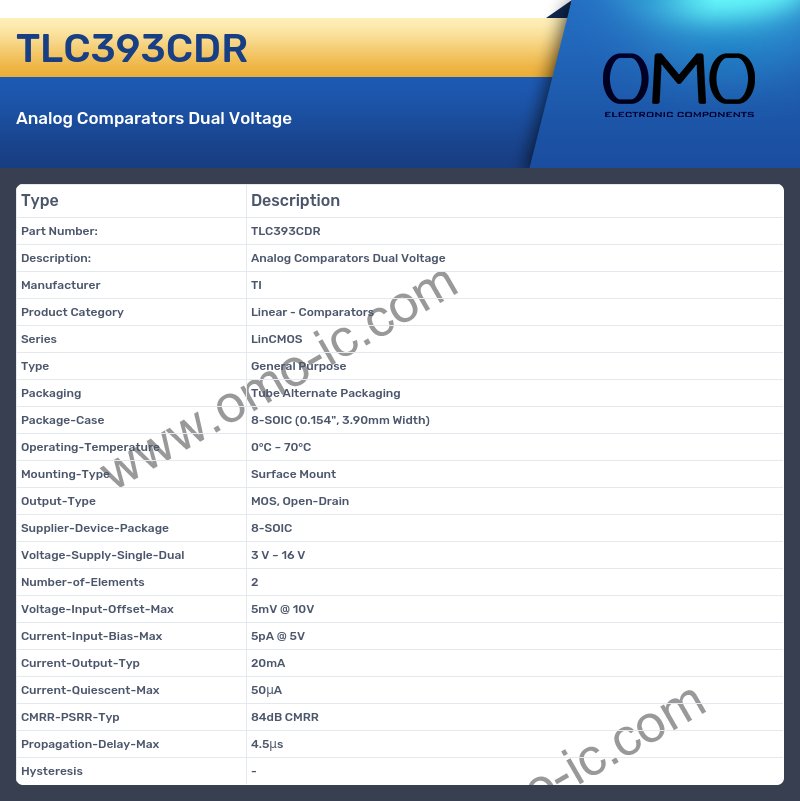
Product belongs to the LinCMOS series. Type: General Purpose Tube Alternate Packaging is the packaging method for this product 8-SOIC (0.154", 3.90mm Width) Operational temperature range: 0°C ~ 70°C Surface Mount mounting type Output-Type: MOS, Open-Drain Supplier device package: 8-SOIC Voltage supply range: 3 V ~ 16 V 2 element 50μA maximum quiescent current. Maximum propagation delay: 4.5μs Hysteresis value of -
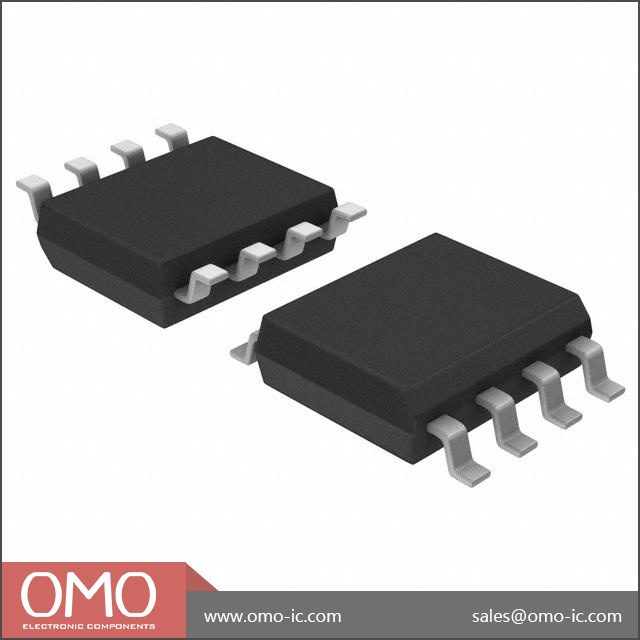
Image shown is a representation only. Exact specifications should be obtained from the product data sheet.
TLC393CDR Specifications
A: Is the cutoff frequency of the product Series?
Q: Yes, the product's Series is indeed LinCMOS
A: What is the Type of the product?
Q: The Type of the product is General Purpose.
A: Is the cutoff frequency of the product Packaging?
Q: Yes, the product's Packaging is indeed Tube Alternate Packaging
A: At what frequency does the Package-Case?
Q: The product Package-Case is 8-SOIC (0.154", 3.90mm Width).
A: At what frequency does the Operating-Temperature?
Q: The product Operating-Temperature is 0°C ~ 70°C.
A: Is the cutoff frequency of the product Mounting-Type?
Q: Yes, the product's Mounting-Type is indeed Surface Mount
A: At what frequency does the Output-Type?
Q: The product Output-Type is MOS, Open-Drain.
A: At what frequency does the Supplier-Device-Package?
Q: The product Supplier-Device-Package is 8-SOIC.
A: At what frequency does the Voltage-Supply-Single-Dual?
Q: The product Voltage-Supply-Single-Dual is 3 V ~ 16 V.
A: At what frequency does the Number-of-Elements?
Q: The product Number-of-Elements is 2.
A: What is the Current-Quiescent-Max of the product?
Q: The Current-Quiescent-Max of the product is 50μA.
A: At what frequency does the Propagation-Delay-Max?
Q: The product Propagation-Delay-Max is 4.5μs.
A: Is the cutoff frequency of the product Hysteresis?
Q: Yes, the product's Hysteresis is indeed -